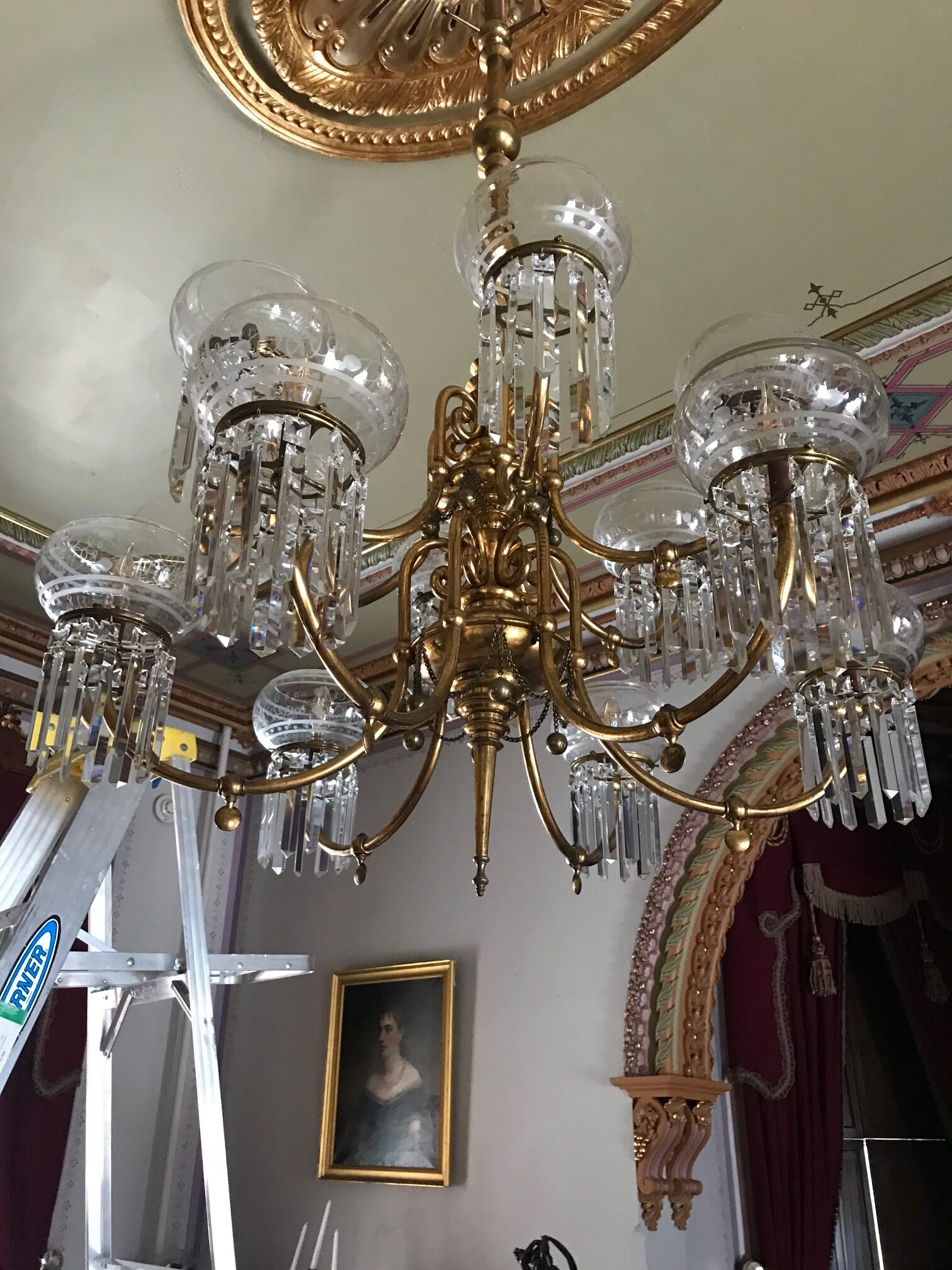
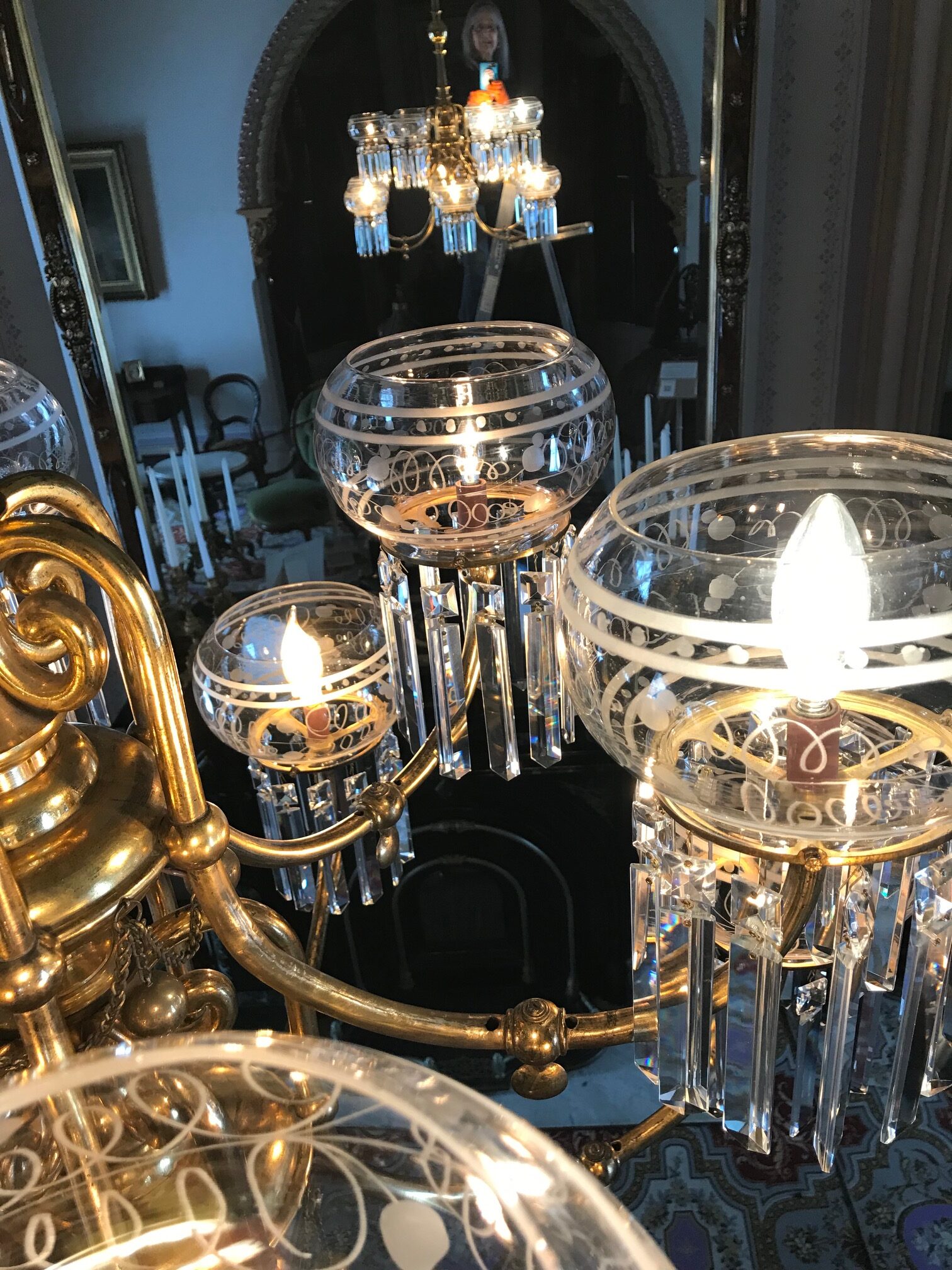
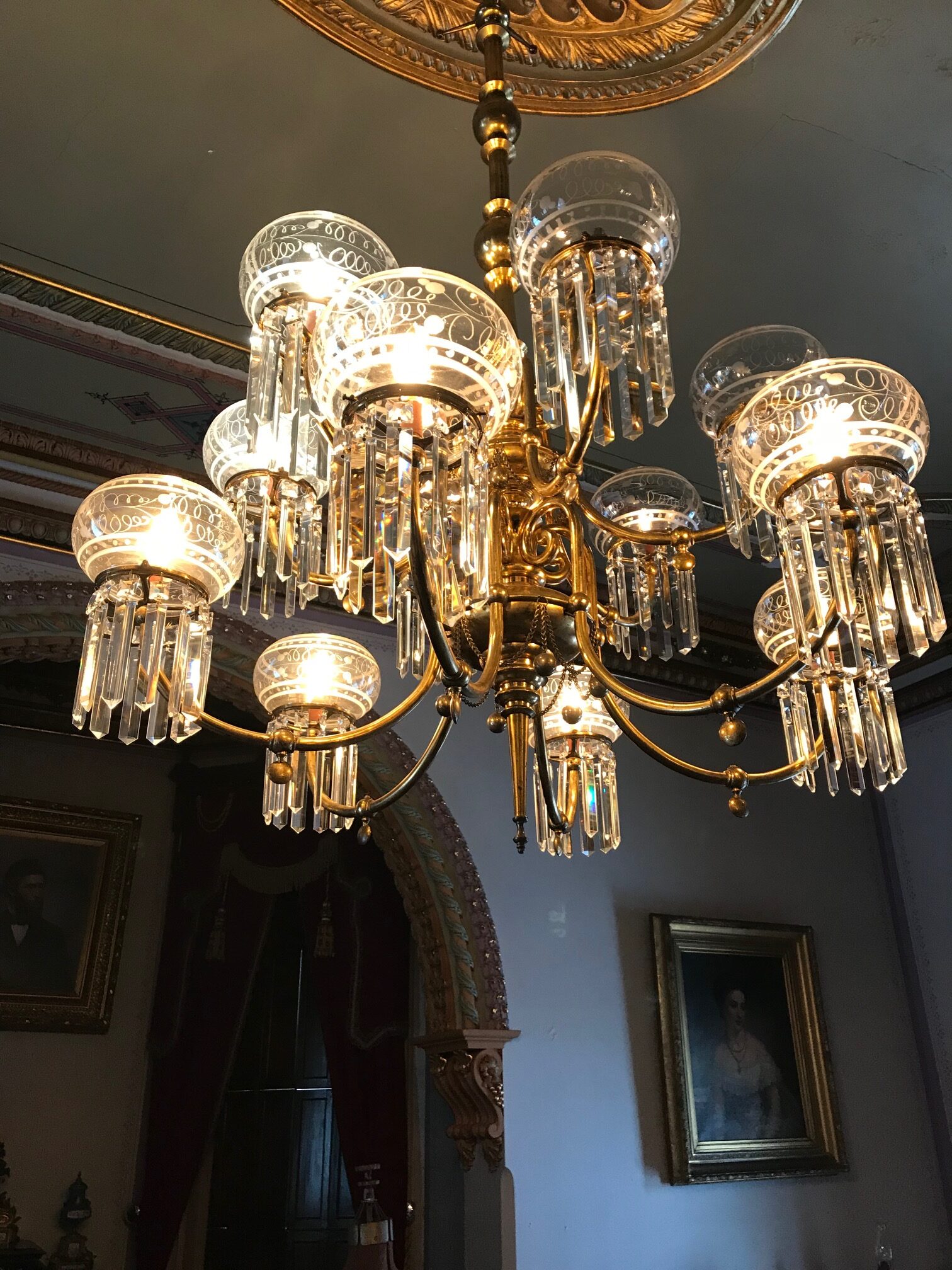
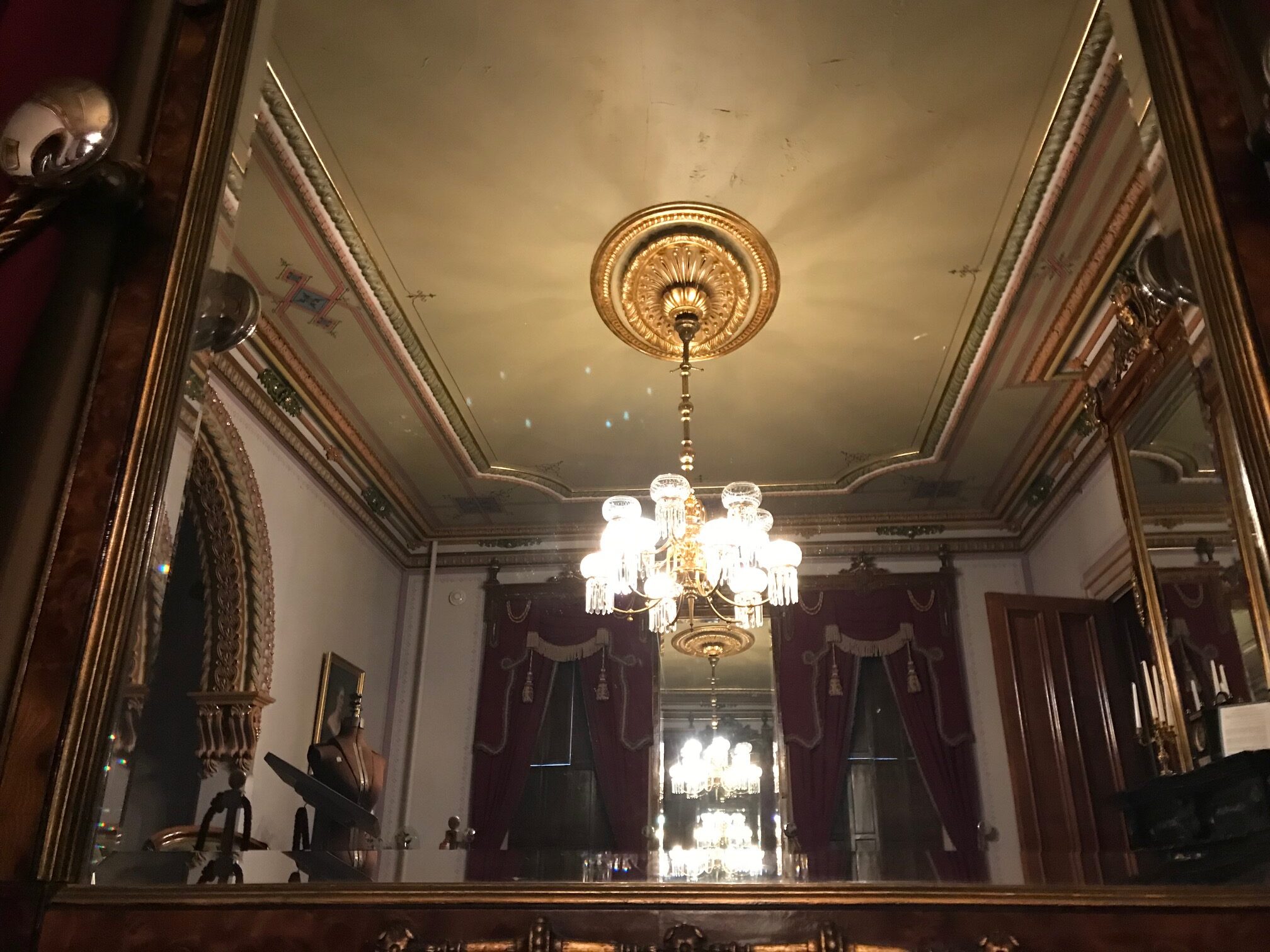
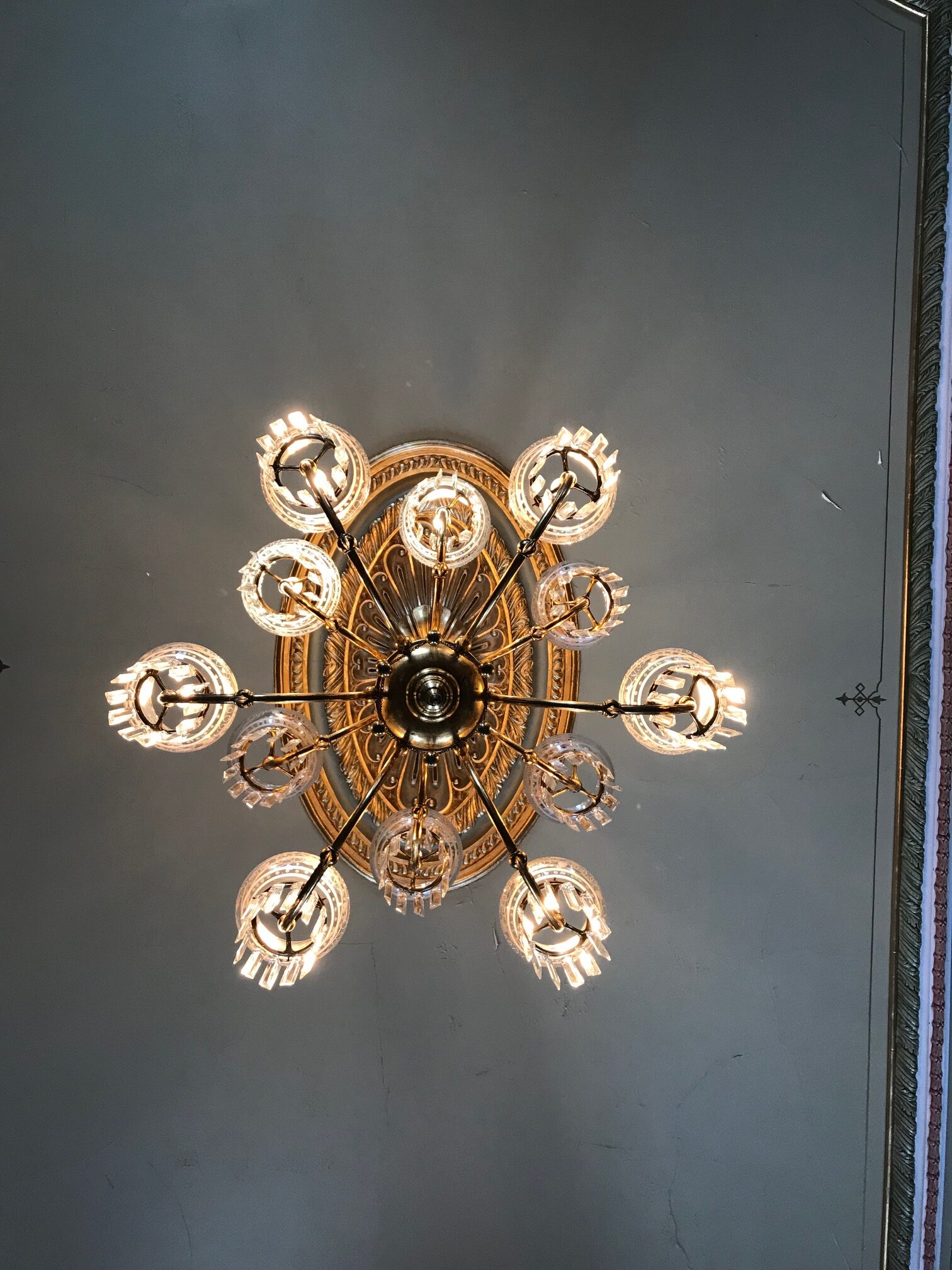
If you have toured the Fenton Mansion/Museum, I’m sure you have noticed the Drawing Room which was restored closer to the Victorian features of the Fenton family home starting in 1988. It was this room where the family would entertain guests, and at night, the gasolier in the middle of the room would have furnished their light. Have you ever wondered how they cleaned it? Or if the gas that fueled the lights made it necessary to be cleaned often?
Each year, usually in January, we close the Mansion/Museum and Research Center for some focused deep cleaning and organizing. In the Mansion, the Christmas Exhibit comes down, items are moved into place for new exhibits, and most maintenance and painting takes place during this time.
At some point, depending on what is already going on in the Drawing Room, I choose a relatively quiet time to get the 12-foot ladder, microfiber cleaning cloths, and get to work on bringing out the sparkle of all those chandelier crystals. This year, as I was beginning the yearly nail-biting adventure, I decided to take photos and share the experience.
For this article, I wanted to use notes that Wendy Chadwick-Case made during her time as Fenton Curator. With her permission, I have taken excerpts from a paper she had written regarding the amazing process of restoring the look of the original gasolier even as it was now electrified.
“When the Fenton Mansion was built in 1863 (-1864), gas was employed to light the gasolier in this room. Over the course of time, (some of) the delicate shades and crystal prisms were broken or removed. After Elizabeth Fenton’s death in 1901, the building sat empty for several years, then it was purchased by the city and the gasolier was crudely electrified.
The gasolier was sent to David Jenks, antique lighting conservator in Syracuse, NY. He attributed the 1875 neo-classically designed, 12 branch, gold plated brass fixture to Mitchell, Vance, and Company, 597 Broadway, NYC. This company was one of the foremost lighting manufacturers for that time. The conservator selectively cleaned the gold-plated brass fixture and cast missing decorative balls. It was then completely rewired in a way that resembles gas fittings. Appropriate shade rings and a set of twelve etched antique shades were found and attached. The 144 crystal prisms are old stock imported from Czechoslovakia.
There is an extra gas cock in the center of the gasolier to which a flexible hose could be attached to supply fuel for a table lamp. Each burner had to be individually illuminated by a device called a torch and key lighter. The “key” was a two-part flange designed to grasp the gas key and turn it on or off. The “torch” was a wax taper that could be slid up and down inside a metal tube. (Barb says, “What could possibly go wrong??”)
“This elegant fixture is seventy inches high and forty inches wide. It is beautifully reflected to infinity in the pier mirrors as you look to your right and to your left.” – Wendy Chadwick-Case
I’m sure the Fenton family cleaning staff had their own issues with the delicacy and stress of not wanting to be the one who broke any part of the gasolier. So, I feel like I’m in good company as I carefully use one damp microfiber cloth in my left hand and a dry microfiber cloth in my right hand and individually clean a year’s worth of dust and film from the fixture, shades, and each of the crystal prisms.
I recently told Wendy that when I get off the ladder for the last time, I take a deep breath and realize I must have been holding my breath a lot. I did, however, fail to thank her for her painstaking attention to detail as she worked out the restoration of the gasolier, the shipping to and from Syracuse, most likely worrying about it until it returned, and all the other Drawing Room details. Thanks to Wendy, Director Candace Larson, Textile Curator Phoebe Forbes, many volunteer workers, and the Sheldon Foundation, the Fenton Drawing Room is still a sight to be seen and loved.